Troubleshooting
This page documents solutions to issues that arose while deploying PST in an integrated environment.
PST LMC and Core pods stuck in “Pending”
During the CSP / CBF / PST integration work in the Low PSI it was found that sometimes PST LMC and Core pods would stay in a “Pending” state as shown in the image below:
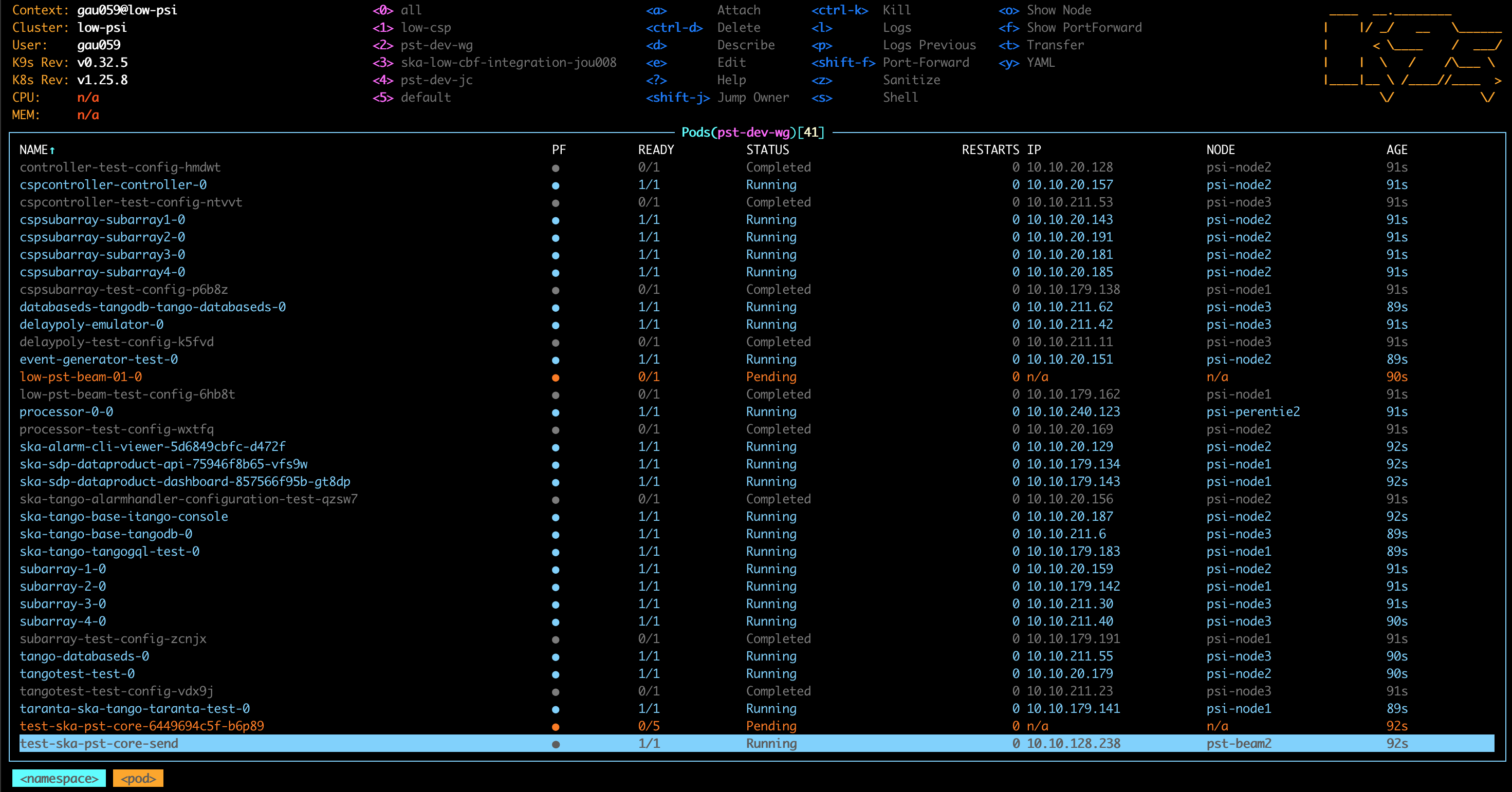
Performing
kubectl describe pod low-pst-beam-01-0
Returned
Events:
  Type     Reason            Age                  From               Message
  ----     ------            ----                 ----               -------
  Warning  FailedScheduling  18s (x6 over 6m19s)  default-scheduler  0/10 nodes are available: 1 node(s) didn't match pod affinity rules, 1 node(s) had untolerated taint {node-role.kubernetes.io/control-plane: true}, 1 node(s) had untolerated taint {skao.int/dedicated: fpga-dev03}, 1 node(s) had untolerated taint {skao.int/dedicated: low-cbf-p4}, 1 node(s) had untolerated taint {skao.int/dedicated: perentie-old}, 1 node(s) had untolerated taint {skao.int/dedicated: perentie}, 1 node(s) had untolerated taint {skao.int/dedicated: pst}, 3 node(s) had volume node affinity conflict. preemption: 0/10 nodes are available: 10 Preemption is not helpful for scheduling.
When checking the PST Core pod we got the following:
Events:
  Type     Reason            Age                    From               Message
  ----     ------            ----                   ----               -------
  Warning  FailedScheduling  3m25s (x6 over 9m28s)  default-scheduler  0/10 nodes are available: 1 node(s) didn't have free ports for the requested pod ports, 1 node(s) had untolerated taint {node-role.kubernetes.io/control-plane: true}, 1 node(s) had untolerated taint {skao.int/dedicated: fpga-dev03}, 1 node(s) had untolerated taint {skao.int/dedicated: low-cbf-p4}, 1 node(s) had untolerated taint {skao.int/dedicated: perentie-old}, 1 node(s) had untolerated taint {skao.int/dedicated: perentie}, 1 node(s) had untolerated taint {skao.int/dedicated: pst}, 3 node(s) didn't match Pod's node affinity/selector. preemption: 0/10 nodes are available: 1 No preemption victims found for incoming pod, 9 Preemption is not helpful for scheduling.
The 1 node(s) didn’t have free ports for the requested pod ports part provided a clue for what was happening; this issue
only appears when using hostNetwork: true because the pod is trying to open a port that is already open on the server.
When using hostNetwork: false (the default value) this issue never arises. However, in an integration environment that
needs to accept data from an external Correlator Beam Former (CBF) the PST core pod needs to have hostNetwork: true.
When multiple instances of ska-pst` with hostNetwork: true` are deployed on the same server, in this case the
pst-beam2 in the psi-low environment, they will by default attempt to use the same port values,
causing the didn’t have free ports failure.
To resolve this a unique values file must be used for each deployment, and each file must specify unique host network port overrides. The following code snippet demonstrates how to override the PST Core ports; in this example, each value is offset from the default value by 5.
ska-pst:
  core:
    applications:
      recv:
        ports:
          mgmt:
            port:       18085
            targetPort: 18085
          datastream:
            port:       32085
            targetPort: 32085
      smrb:
        ports:
          mgmt:
            port:       18086
            targetPort: 18086
      dsp_disk:
        ports:
          mgmt:
            port:       18087
            targetPort: 18087
      stat:
        ports:
          mgmt:
            port:       18088
            targetPort: 18088
      dsp_ft:
        ports:
          mgmt:
            port:       18089
            targetPort: 18089
After applying this change PST pods got to a Running state within Kubernetes.
PST LMC Device fails to initialise
During the device init process, the PST LMC device tries to connect to the PST core signal processing applications via gRPC requests. We have seen this fail in the CSP / CBF / PST environment.
The following is a snippet of the log of the PST LMC pod:
Tango NamedDevFailedList exception
  Exception for object simulationMode
  Index of object in call (starting at 0) = 0
      Severity = ERROR
      Error reason = PyDs_PythonError
      Desc : grpc._channel._InactiveRpcError: <_InactiveRpcError of RPC that terminated with:
    status = StatusCode.UNAVAILABLE
    details = "failed to connect to all addresses; last error: UNKNOWN: ipv4:130.155.198.233:8888: HTTP proxy returned response code 403"
    debug_error_string = "UNKNOWN:Error received from peer  {grpc_message:"failed to connect to all addresses; last error: UNKNOWN: ipv4:130.155.198.233:8888: HTTP proxy returned response code 403", grpc_status:14, created_time:"2024-07-03T07:09:42.788604737+00:00"}"
>
      Origin : Traceback (most recent call last):
  File "/usr/local/lib/python3.10/dist-packages/tango/server.py", line 159, in write_attr
    return get_worker().execute(write_method, self, value)
  File "/usr/local/lib/python3.10/dist-packages/tango/green.py", line 113, in execute
    return fn(*args, **kwargs)
  File "/app/python/src/ska_pst/lmc/component/pst_device.py", line 377, in simulationMode
    self.component_manager.simulation_mode = value
  File "/app/python/src/ska_pst/lmc/component/component_manager.py", line 177, in simulation_mode
    self._simulation_mode_changed()
  File "/app/python/src/ska_pst/lmc/beam/beam_component_manager.py", line 572, in _simulation_mode_changed
    self._smrb_subcomponent.simulation_mode = self.simulation_mode
  File "/app/python/src/ska_pst/lmc/component/subcomponent_manager.py", line 111, in simulation_mode
    self._simulation_mode_changed()
  File "/app/python/src/ska_pst/lmc/component/subcomponent_manager.py", line 317, in _simulation_mode_changed
    self._update_api()
  File "/app/python/src/ska_pst/lmc/component/subcomponent_manager.py", line 536, in _update_api
    self._api.connect()
  File "/app/python/src/ska_pst/lmc/component/process_api.py", line 491, in connect
    _connect()
  File "/usr/local/lib/python3.10/dist-packages/backoff/_sync.py", line 105, in retry
    ret = target(*args, **kwargs)
  File "/app/python/src/ska_pst/lmc/component/process_api.py", line 489, in _connect
    self._connected = self._grpc_client.connect()
  File "/app/python/src/ska_pst/lmc/component/grpc_lmc_client.py", line 237, in connect
    self._service.connect(request)
  File "/usr/local/lib/python3.10/dist-packages/grpc/_channel.py", line 1176, in __call__
    return _end_unary_response_blocking(state, call, False, None)
  File "/usr/local/lib/python3.10/dist-packages/grpc/_channel.py", line 1005, in _end_unary_response_blocking
    raise _InactiveRpcError(state)  # pytype: disable=not-instantiable
grpc._channel._InactiveRpcError: <_InactiveRpcError of RPC that terminated with:
    status = StatusCode.UNAVAILABLE
    details = "failed to connect to all addresses; last error: UNKNOWN: ipv4:130.155.198.233:8888: HTTP proxy returned response code 403"
    debug_error_string = "UNKNOWN:Error received from peer  {grpc_message:"failed to connect to all addresses; last error: UNKNOWN: ipv4:130.155.198.233:8888: HTTP proxy returned response code 403", grpc_status:14, created_time:"2024-07-03T07:09:42.788604737+00:00"}"
>
This error suggested that it was going through a HTTP proxy to get to the service
test-ska-pst-core.low-csp.svc.cluster.local:28081. The root cause of this was that the deployment had specified
a HTTP/HTTPS proxy without specifying a no_proxy value, this meant that the gRPC was attempting to go through
the HTTP proxy when the service was within the Kubernetes cluster and namespace. The following is a snippet of
the Helm values file that caused the issue.
global:
  environment_variables:
    - name: https_proxy
      value: "http://delphoenix.atnf.csiro.au:8888"
    - name: http_proxy
      value: "http://delphoenix.atnf.csiro.au:8888"

  # other values
The following code snippet shows how this was resolved:
global:
  environment_variables:
    - name: https_proxy
      value: "http://delphoenix.atnf.csiro.au:8888"
    - name: http_proxy
      value: "http://delphoenix.atnf.csiro.au:8888"
    - name: no_proxy
      value: "cluster.local"
The no_proxy value should match the global variable cluster_domain which defaults to cluster.local. The
following shows how to set the proxy with a no_proxy when the cluster_domain is set.
global:
  cluster_domain: psi-low.k8s.skao.int
  environment_variables:
    - name: https_proxy
      value: "http://delphoenix.atnf.csiro.au:8888"
    - name: http_proxy
      value: "http://delphoenix.atnf.csiro.au:8888"
    - name: no_proxy
      value: "psi-low.k8s.skao.int"
PST errors during ConfigureScan
Generally the error for this should be a validation error. However, it is possible that the required bandwidth of the scan could cause an OutOfMemory limit error in Kubernetes which then results in RECV.CORE application being terminated by the Linux kernel.
When this happens the health check between PST LMC and the RECV.CORE application will fail and an exception will be logged in the LMC logs.
File "/app/python/src/ska_pst/lmc/component/grpc_lmc_client.py", line 211, in _wrapper
  return func(client, *args, timeout=timeout, **kwargs)
File "/app/python/src/ska_pst/lmc/component/grpc_lmc_client.py", line 361, in configure_beam
  self._service.configure_beam(request, timeout=timeout)
File "/usr/local/lib/python3.10/dist-packages/grpc/_channel.py", line 1181, in __call__
  return _end_unary_response_blocking(state, call, False, None)
File "/usr/local/lib/python3.10/dist-packages/grpc/_channel.py", line 1006, in _end_unary_response_blocking
  raise _InactiveRpcError(state)  # pytype: disable=not-instantiable
grpc._channel._InactiveRpcError: <_InactiveRpcError of RPC that terminated with:
        status = StatusCode.UNAVAILABLE
        details = "Socket closed"
        debug_error_string = "UNKNOWN:Error received from peer  {created_time:"2025-06-11T07:50:53.031132144+00:00", grpc_status:14, grpc_message:"Socket closed"}"
>

The above exception was the direct cause of the following exception:

Traceback (most recent call last):
  File "/app/python/src/ska_pst/lmc/component/grpc_process_api.py", line 214, in configure_beam
    self._grpc_client.configure_beam(request=request, timeout=timeout)
  File "/app/python/src/ska_pst/lmc/component/grpc_lmc_client.py", line 213, in _wrapper
    _handle_grpc_error(e, timeout=timeout)
  File "/app/python/src/ska_pst/lmc/component/grpc_lmc_client.py", line 266, in _handle_grpc_error
    _handle_server_error(error, timeout)
  File "/app/python/src/ska_pst/lmc/component/grpc_lmc_client.py", line 234, in _handle_server_error
    raise ServiceUnavailable(error_code=error_code, message=message) from error
ska_pst.lmc.component.grpc_lmc_client.ServiceUnavailable
1|2025-06-11T07:50:53.040Z|WARNING|ParallelTaskThread_1|go_to_fault|grpc_process_api.py#411|tango-device:low-pst/beam/01|Error in trying to put remote service 'low-pst/beam/01/recv' in FAULT state.
Traceback (most recent call last):
  File "/app/python/src/ska_pst/lmc/component/grpc_lmc_client.py", line 211, in _wrapper
    return func(client, *args, timeout=timeout, **kwargs)
  File "/app/python/src/ska_pst/lmc/component/grpc_lmc_client.py", line 361, in configure_beam
    self._service.configure_beam(request, timeout=timeout)
  File "/usr/local/lib/python3.10/dist-packages/grpc/_channel.py", line 1181, in __call__
    return _end_unary_response_blocking(state, call, False, None)
  File "/usr/local/lib/python3.10/dist-packages/grpc/_channel.py", line 1006, in _end_unary_response_blocking
    raise _InactiveRpcError(state)  # pytype: disable=not-instantiable
grpc._channel._InactiveRpcError: <_InactiveRpcError of RPC that terminated with:
        status = StatusCode.UNAVAILABLE
        details = "Socket closed"
        debug_error_string = "UNKNOWN:Error received from peer  {created_time:"2025-06-11T07:50:53.031132144+00:00", grpc_status:14, grpc_message:"Socket closed"}"
The above exception was the direct cause of the following exception:

Traceback (most recent call last):
  File "/app/python/src/ska_pst/lmc/util/streaming_task.py", line 93, in start
    for v in self._item_generator(self._abort_event):
  File "/app/python/src/ska_pst/lmc/component/grpc_lmc_client.py", line 715, in perform_health_check
    _handle_grpc_error(e, timeout=timeout)
  File "/app/python/src/ska_pst/lmc/component/grpc_lmc_client.py", line 266, in _handle_grpc_error
    _handle_server_error(error, timeout)
  File "/app/python/src/ska_pst/lmc/component/grpc_lmc_client.py", line 234, in _handle_server_error
    raise ServiceUnavailable(error_code=error_code, message=message) from error
ska_pst.lmc.component.grpc_lmc_client.ServiceUnavailable
1|2025-06-11T07:50:53.845Z|ERROR|Thread-23 (_run)|_handle_health_check_exception|api_subcomponent_manager.py#473|tango-device:low-pst/beam/01|Health check for RECV has raised an exception: . Restarting health check
1|2025-06-11T07:50:53.845Z|WARNING|Thread-30 (_run)|handle_health_state_change|beam_component_manager.py#1493|tango-device:low-pst/beam/01|RECV health state is in FAILED state. Putting 1 into FAILED state
During the development of v1.1.0 of PST the default memory limit was reduced but this affected
the deployments to environments run by TOPIC but this now has been reverted back to the default
value used in previous versions. The issue can be resolved by increasing the memory limits
for the core applications within the Helm values.yaml file when doing a Helm deployment. The following
code snippet shows what value to override. For more information about the Helm parameters check the
SKA PST Helm Chart Parameters page.
ska-pst:
  core:
    resources:
      limits:
        cpu: 1600m
        memory: 6400Mi # <-- increase this value
      requests:
        cpu: 1600m
        memory: 2000Mi