Subrack Device
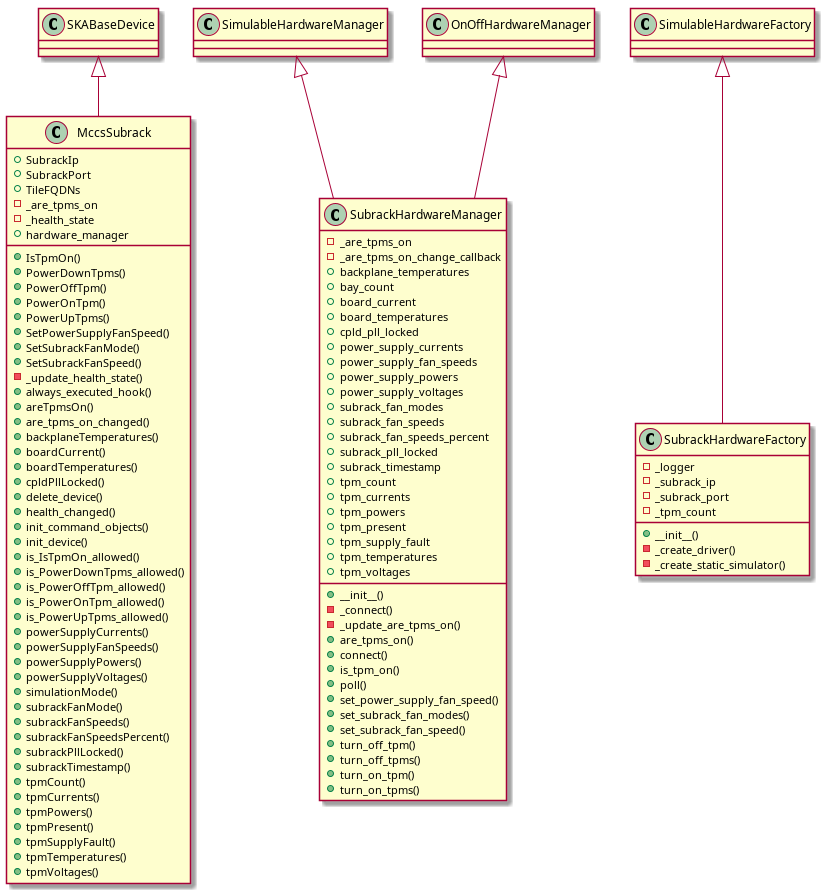
This module provides a Tango device for an SPS subrack.
- class MccsSubrack(*args, **kwargs)
A Tango device for monitor and control of an SPS subrack.
- PowerDownTpms()
Power down all TPMs.
- Return type:
TaskFunctionType- Returns:
A tuple containing a return code and a string message indicating status. The message is for information purposes only.
- PowerOffTpm(tpm_number)
Power down a TPM.
- Parameters:
tpm_number (
int) – the logical id of the TPM to power down- Return type:
TaskFunctionType- Returns:
A tuple containing a return code and a string message indicating status. The message is for information purposes only.
- PowerOnTpm(tpm_number)
Power up a TPM.
- Parameters:
tpm_number (
int) – the logical id of the TPM to power up- Return type:
TaskFunctionType- Returns:
A tuple containing a return code and a string message indicating status. The message is for information purposes only.
- PowerPduPortOff(port_number)
Turn the selected pdu port off.
- Parameters:
port_number (
int) – pdu port number- Return type:
TaskFunctionType- Returns:
A tuple containing a return code and a string message indicating status. The message is for information purpose only.
- PowerPduPortOn(port_number)
Turn the selected pdu port on.
- Parameters:
port_number (
int) – pdu port number- Return type:
TaskFunctionType- Returns:
A tuple containing a return code and a string message indicating status. The message is for information purpose only.
- PowerUpTpms()
Power up all TPMs.
- Return type:
TaskFunctionType- Returns:
A tuple containing a return code and a string message indicating status. The message is for information purposes only.
- ScheduleOff()
Turn self off.
- Return type:
TaskFunctionType- Returns:
A tuple containing a return code and a string message indicating status. The message is for information purpose only.
- ScheduleOn()
Turn self on.
- Return type:
TaskFunctionType- Returns:
A tuple containing a return code and a string message indicating status. The message is for information purpose only.
- SetPowerSupplyFanSpeed(power_supply_fan_id, speed_percent)
Set the selected power supply fan speed.
A json dictionary with mandatory keywords
- SetSubrackFanMode(fan_id, mode)
Set the selected subrack backplane fan mode.
A json dictionary with mandatory keywords
- SetSubrackFanSpeed(subrack_fan_id, speed_percent)
Set the selected subrack backplane fan speed.
A json dictionary with mandatory keywords
- UpdateHealthAttributes()
Request the subrack driver to poll the health status attributes.
- Return type:
TaskFunctionType- Returns:
A tuple containing a return code and a string message indicating status. The message is for information purposes only.
- property UseAttributesForHealth
Use the attribute quality factor in health. ADR-115.
- __init__(*args, **kwargs)
Initialise this device object.
- attributeFilterType()
Get the attribute filter type.
- Return type:
- Returns:
The attribute filter type.
- backplaneTemperatures()
Handle a Tango attribute read of the subrack backplane temperature.
Two values are returned, respectively for the first (bays 1-4) and second (bays 5-8) halves of the backplane.
- boardCurrent()
Handle a Tango attribute read of subrack management board current.
Total current provided by the two power supplies.
- boardTemperatures()
Handle a Tango attribute read of the subrack board temperature.
Two values are returned.
- cpldPllLocked()
Handle a Tango attribute read of the subrack CPLD PLL locked attribute.
- create_component_manager()
Create and return a component manager for this device.
- Return type:
- Returns:
a component manager for this device.
- healthModelParams(argin)
Set the params for health transition rules.
- healthStatus()
Handle a dictionary of all available monitoring points.
- init_device()
Initialise the device.
This is overridden here to change the Tango serialisation model.
- Return type:
- pduHealth()
Handle a Tango attribute read of the pdu health.
- pduModel()
Handle a Tango attribute read of the pdu model type.
- pduNumberPorts()
Handle a Tango attribute read of thenumber of pdu ports.
- pduPortCurrents()
Handle a Tango attribute read of the current of pdu port.
- pduPortStates()
Handle a Tango attribute read of the state of pdu port.
- pduPortVoltages()
Handle a Tango attribute read of the current of pdu port.
- powerSupplyCurrents()
Handle a Tango attribute read of the power supply currents.
- powerSupplyFanSpeeds()
Handle a Tango attribute read of the power supply fan speeds.
Values expressed in percent of maximum.
- powerSupplyPowers()
Handle a Tango attribute read of the power supply powers.
- powerSupplyVoltages()
Handle a Tango attribute read of the power supply voltages.
- psu1Load()
Return the fractional loading on PSU 1.
- property psu1PowerIn: float
PSU1 input power in Watts.
- Unit:
Watt
- Max warning:
575.0
- Max alarm:
600.0
- property psu1PowerOut: float
PSU1 output power in Watts.
- Unit:
Watt
- Max warning:
600.0
- Max alarm:
1140.0
- property psu1Present
Presence of PSU1.
- property psu1VoltageIn: float
PSU1 input voltage in Volts.
- Unit:
Volt
- Min warning:
215.0
- Max warning:
240.0
- Min alarm:
207.0
- Max alarm:
253.0
- property psu1VoltageOut: float
PSU1 output voltage in Volts.
- Unit:
Volt
- Min warning:
11.0
- Max warning:
13.0
- Min alarm:
10.0
- Max alarm:
14.0
- psu2Load()
Return the fractional loading on PSU 2.
- property psu2PowerIn: float
PSU2 input power in Watts.
- Unit:
Watt
- Max warning:
575.0
- Max alarm:
600.0
- property psu2PowerOut: float
PSU2 output power in Watts.
- Unit:
Watt
- Max warning:
600.0
- Max alarm:
1140.0
- property psu2Present
Presence of PSU2.
- property psu2VoltageIn: float
PSU2 input voltage in Volts.
- Unit:
Volt
- Min warning:
215.0
- Max warning:
240.0
- Min alarm:
207.0
- Max alarm:
253.0
- property psu2VoltageOut: float
PSU2 output voltage in Volts.
- Unit:
Volt
- Min warning:
11.0
- Max warning:
13.0
- Min alarm:
10.0
- Max alarm:
14.0
- property psuDeadCount: int
Count of PSUs that are present and receive input voltage but supply no output voltage.
- Max warning:
1
- Max alarm:
2
- subrackBoardInfo()
Handle a Tango attribute read of the Subrack board info.
- subrackFanModes()
Handle a Tango attribute read of the subrack fan modes.
- subrackFanSpeeds()
Handle a Tango attribute read of the subrack fan speeds, in RPM.
- subrackFanSpeedsPercent()
Handle a Tango attribute read of the subrack fan speeds, in percent.
This is the commanded setpoint; the relation between this level and the actual RPMs is not linear. Subrack speed is managed automatically by the controller, by default (see subrack_fan_mode).
Commanded speed is the same for fans 1-2 and 3-4.
- subrackMaxFanSpeeds()
Return the estimated rpm speed of the fans at 100% pwm duty.
Uses the FanSpeedsPercent attribute to scale up the FanSpeeds attribute to what the maximum value would be.
- Return type:
np.ndarray | None
- Returns:
the scaled subrack fan speeds. When communication with the subrack is not established, this returns none.
- subrackPllLocked()
Handle a Tango attribute read of the subrack PLL locked attribute.
- subrackTimestamp()
Handle a Tango attribute read of the subrack timestamp attribute.
- tpm1PowerState()
Handle a Tango attribute read of the power state of TPM 1.
- Return type:
- Returns:
the power state of TPM 1.
- tpm2PowerState()
Handle a Tango attribute read of the power state of TPM 2.
- Return type:
- Returns:
the power state of TPM 2.
- tpm3PowerState()
Handle a Tango attribute read of the power state of TPM 3.
- Return type:
- Returns:
the power state of TPM 3.
- tpm4PowerState()
Handle a Tango attribute read of the power state of TPM 4.
- Return type:
- Returns:
the power state of TPM 4.
- tpm5PowerState()
Handle a Tango attribute read of the power state of TPM 5.
- Return type:
- Returns:
the power state of TPM 5.
- tpm6PowerState()
Handle a Tango attribute read of the power state of TPM 6.
- Return type:
- Returns:
the power state of TPM 6.
- tpm7PowerState()
Handle a Tango attribute read of the power state of TPM 7.
- Return type:
- Returns:
the power state of TPM 7.
- tpm8PowerState()
Handle a Tango attribute read of the power state of TPM 8.
- Return type:
- Returns:
the power state of TPM 8.
- tpmCount()
Handle a Tango attribute read of TPM count.
- Return type:
- Returns:
the number of TPMs present in the subrack. When communication with the subrack is not established, this returns 0.
- tpmCurrents()
Handle a Tango attribute read of the TPM currents.
- tpmPowers()
Handle a Tango attribute read of the TPM powers.
- tpmPresent()
Handle a Tango attribute read of which TPMs are present in the subrack.
- tpmVoltages()
Handle a Tango attribute read of the TPM voltages.