Getting started
This page will guide you through the steps to writing a SKA Tango device
based on the ska-tango-base package.
Prerequisites
It is assumed here that you have a subproject repository, and have set
up your development environment. The ska-tango-base package can be
installed from the SKAO repository:
me@local:~$ python3 -m pip --require-virtualenv install --extra-index-url https://artefact.skao.int/repository/pypi-all/simple ska-tango-base
Basic steps
The recommended basic steps to writing a SKA Tango device based on the
ska-tango-base package are:
Write a component manager.
Implement command class objects.
Write your Tango device.
Detailed steps
Write a component manager
A fundamental assumption of this package is that each Tango device exists to provide monitoring and control of some component of a SKA telescope. That component could be some hardware, a software service or process, or even a group of subservient Tango devices.
A component manager provides for monitoring and control of a component. It is highly recommended to implement and thoroughly test your component manager before embedding it in a Tango device.
For more information on components and component managers, see Components and component managers.
Writing a component manager involves the following steps.
Choose a subclass for your component manager. There are several component manager base classes, each associated with a device class. For example,
If your Tango device will inherit from
SKABaseDevice, then you will probably want to base your component manager on theBaseComponentManagerclass.If your Tango device is a subarray, then you will want to base your component manager on
SubarrayComponentManager.

These component managers are abstract. They specify an interface, but leave it up to you to implement the functionality. For example,
BaseComponentManager’son()command looks like this:def on(self): raise NotImplementedError("BaseComponentManager is abstract.")
Your component manager will inherit these methods, and override them with actual implementations.
Note
In addition to these abstract classes, there are also reference implementations of concrete subclasses. For example, in addition to an abstract
BaseComponentManager, there is also a concreteReferenceBaseComponentManager. These reference implementations are provided for explanatory purposes: they illustrate how a concrete component manager might be implemented. You are encouraged to review the reference implementations, and adapt them to your own needs; but it is not recommended to subclass from them.Establish communication with your component. How you do this will depend on the capabilities and interface of your component. for example:
If the component interface is via a connection-oriented protocol (such as TCP/IP), then the component manager must establish and maintain a connection to the component;
If the component is able to publish updates, then the component manager would need to subscribe to those updates;
If the component cannot publish updates, but can only respond to requests, then the component manager would need to initiate polling of the component.
Implement component monitoring. Whenever your component changes its state, your component manager needs to become reliably aware of that change within a reasonable time frame, so that it can pass this on to the Tango device.
The abstract component managers provided already contain some helper methods to trigger device callbacks. For example,
BaseComponentManagerprovides acomponent_faultmethod that lets the device know that the component has experienced a fault. You need to implement component monitoring so that, if the component experiences a fault, this is detected, and results in thecomponent_faulthelper method being called.For component-specific functionality, you will need to implement the corresponding helper methods. For example, if your component reports its temperature, then your component manager will need to
Implement a mechanism by which it can let its Tango device know that the component temperature has changed, such as a callback;
Implement monitoring so that this mechanism is triggered whenever a change in component temperature is detected.
Implement component control. Methods to control the component must be implemented; for example the component manager’s
on()method must be implemented to actually tell the component to turn on.Note that component control and component monitoring are decoupled from each other. So, for example, a component manager’s
on()method should not directly call the callback that tells the device that the component is now on. Rather, the command should return without calling the callback, and leave it to the monitoring to detect when the component has changed states.Consider, for example, a component that takes ten seconds to power up:
The
on()command should be implemented to tell the component to power up. If the component accepts this command without complaint, then theon()command should return success. The component manager should not, however, assume that the component is now on.After ten seconds, the component has powered up, and the component manager’s monitoring detects that the component is on. Only then should the callback be called to let the device know that the component has changed state, resulting in a change of device state to
ON.
Note
A component manager may maintain additional state, and support
additional commands, that do not map to its component. That is, a
call to a component manager needs not always result in a call to the
underlying component. For example, a subarray’s component manager may
implement its assign_resources method simply to maintain a record
(within the component manager itself) of what resources it has, so
that it can validate arguments to other methods (for example, check
that arguments to its configure method do not require access to
resources that have not been assigned to it). In this case, the call
to the component manager’s assign_resources method would not
result in interaction with the component; indeed, the component may
not even possess the concepts of resources and resource
assignment.
Implement command class objects
Tango device command functionality is implemented in command classes rather than methods. This allows for:
functionality common to many classes to be abstracted out and implemented once for all. For example, there are many commands associated with transitional states (e.g.
Configure()command andCONFIGURINGstate,Scan()command andSCANNINGstate, etc.). Command classes allow us to implement this association once for all, and to protect that implementation from accidental overriding by command subclasses.testing of commands independently of Tango. For example, a Tango device’s
On()command might only need to interact with the device’s component manager and its operational state model. As such, in order to test the correct implementation of that command, we only need a component manager and an operational state model. Thus, we can test the command without actually instantiating the Tango device.
Writing a command class involves the following steps.
Do you really need to implement the command? If the command to be implemented is part of the Tango device you will inherit from, perhaps the current implementation is exactly what you need.
For example, the
SKABaseDeviceclass’s implementation of theOn()command simply calls its component manager’son()method. Maybe you don’t need to change that; you’ve implemented your component manager’son()method, and that’s all there is to do.Choose a command class to subclass.
If the command to be implemented is part of the device you will inherit from (but you still need to override it), then you would generally subclass the base device’s command class. For example, if if you need to override
SKABaseDevice’sStandbycommand, then you would subclassSKABaseDevice.StandbyCommand.If the command is a new command, not present in the base device class, then you will want to inherit from one or more command classes in the
ska_tango_base.commandsmodule.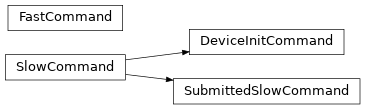
Implement class methods.
In many cases, you only need to implement the
do()method.
Write your Tango device
Writing the Tango device involves the following steps:
Select a device class to subclass.
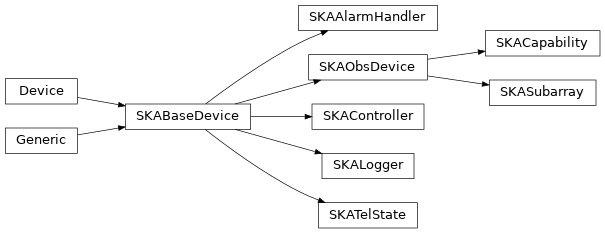
Register your component manager. This is done by overriding the
create_component_managerclass to return your component manager object:def create_component_manager(self): return AntennaComponentManager( self.op_state_model, logger=self.logger, communication_state_callback=self._communication_state_callback, component_state_callback=self._component_state_callback )
When instantiating a component manager object that inherits directly or indirectly from
BaseComponentManager, two callbacks should be provided by the Tango device, one for the communication state and the other for the component state. These callbacks allow the component manager to inform the Tango device of changes to the component while staying decoupled from the device itself.For instance, the derived component manager class will inherit
_update_communication_statefromBaseComponentManager, which internally calls the suppliedcommunication_state_callback. The derived class will then use_update_communication_statewhen overridingstart_communicatingandstop_communicatingto drive theop_state_model. Similarly, when the component manager determines that the power or fault status of the component has changed, it will use_update_component_stateto drive theop_state_model.At a minimum, to ensure the actions are perfromed on the
op_state_model, both callbacks should call the relevant <type>_state_changedSKABaseDevicemethod.Communication state - Perform actions based on the input communication_state (
CommunicationStatustype from ska_control_model).SKABaseDevicemethod:_communication_state_changedOp state actions:
component_disconnected,component_unknown.Minimum example:
def _communication_state_callback(
 communication_state: CommunicationStatus
 ) -> None:
     super()._communication_state_changed(communication_state)
Component state - Perform actions based on the input fault (boolean) and/or power (
PowerStatetype from ska_control_model).SKABaseDevicemethod:_component_state_changedOp state actions:
component_fault,component_no_fault,component_on,component_standby,component_off.Minimum example:
def _component_state_callback(
    fault: Optional[bool] = None,
    power: Optional[PowerState] = None
 ) -> None:
     super()._component_state_changed(fault=fault, power=power)
Information the component manager retrieves from the component needs to be made available to the wider control system in the form of attributes on the Tango device. This can be done with the use of additonal keyword arguments provided to the callbacks above that are used to update said attributes. However, a device with many different sensors could then end up with a long list of keyword arguments, and a cumbersome callback. It is recommended to split these additional arguments into their own callback(s) by adding methods to the Tango device with corresponding parameters in the derived component manager.
Components may be software instead of hardware. In this case the
SKABaseDevice._component_state_changedmethod should still be called with a power argument to drive theop_state_model, e.g.PowerState.ONto arrive in the ON operational state. AlternativelySKABaseDevice._communication_state_changedcould be overridden so that acommunication_stateofCommunicationStatus.ESTABLISHEDinstead transitions the operational state to ON.Implement commands. You’ve already written the command classes. There is some boilerplate to ensure that the Tango command methods invoke the command classes:
Registration occurs in the
init_command_objectsmethod, using calls to theregister_command_objecthelper method. Implement theinit_command_objectsmethod:def init_command_objects(self): super().init_command_objects() self.register_command_object( "DoStuff", self.DoStuffCommand(self.component_manager, self.logger) ) self.register_command_object( "DoOtherStuff", self.DoOtherStuffCommand( self.component_manager, self.logger ) )
Any new commands need to be implemented as:
@command(dtype_in=..., dtype_out=...)
def DoStuff(self, argin):
    command = self.get_command_object("DoStuff")
    return command(argin)
or, if the command does not take an argument:
@command(dtype_out=...)
def DoStuff(self):
    command = self.get_command_object("DoStuff")
    return command()
Note that these two examples deliberately push all SKA business logic down to the command class (at least) or even the component manager. It is highly recommended not to include SKA business logic in Tango devices. However, Tango-specific functionality can and should be implemented directly into the command method. For example, many SKA commands accept a JSON string as argument, as a workaround for the fact that Tango commands cannot accept more than one argument. Since this use of JSON is closely associated with Tango, we might choose to unpack our JSON strings in the command method itself, thus leaving our command objects free of JSON:
@command(dtype_in=..., dtype_out=...)
def DoStuff(self, argin):
    args = json.loads(argin)
    command = self.get_command_object("DoStuff")
    return command(args)