Developer Documentation
Quickstart
This is a pure Python library that uses poetry to manage dependencies.
Execute the test suite and lint the project with:
poetry install --with=dev && poetry shell
make python-test && make python-lint
Format the Python code:
make python-format
Makefile targets
This project contains a Makefile Gitlab Submodule which acts as a UI for building Docker images, testing images, and for launching interactive developer environments. The following make targets are defined:
Makefile target |
Description |
|---|---|
python-test |
Test the application image |
python-lint |
Lint the application image |
python-format |
Format the Python code |
help |
show a summary of the makefile targets above |
Background
SKA Tango devices have commands that accept structured arguments and/or return structured responses. These structured data are often expressed as JSON-formatted strings.
The Configuration Data Model (CDM) is a data model used to describe subarray resource allocations and the subsequent configuration of those resources. It is effectively the superset of the configurations used by receptors, correlators, and data processing systems. The CDM is one such example of structured data delivered to TMC Tango devices.
This project defines object representations of the structured data passed to and from Tango devices, and serialisation schema used to convert the structured data to and from JSON. This project defines:
a Python object model of the CDM;
a Python object model for the structured arguments sent to TMC Tango devices and the structured responses received in return;
validation of the JSON strings sent between devices are compliant with the agreed interfaces.
The primary users of this shared library are the OET, SubArrayNode, and CentralNode. The OET uses this library to construct object representations of telescope configurations and resource allocation instructions, to convert those object representations to JSON-formatted payloads for TMC devices, and finally to convert the JSON responses returned by TMC devices back into Python objects.
It is intended that TMC devices also use this library to guarantee correct data exchange with the OET. TMC can also use this library to marshall and unmarshall its arguments to CSP and SDP Tango devices, which accept the appropriate subset of the JSON.
Project layout
The CDM project contains three top-level packages, ska_tmc_cdm.messages,
ska_tmc_cdm.schemas and ska_tmc_cdm.jsonschema as shown in the figure below.
The ska_tmc_cdm.messages
package contains Python object models for the JSON command arguments agreed
in the ICDs. The ska_tmc_cdm.schemas package contains a Codec class that provides an
interface to transform ska_tmc_cdm.messages to and from JSON.
The ska_tmc_cdm.jsonschema package contains
code to verify that the JSON strings sent between devices are compliant with the agreed interfaces.
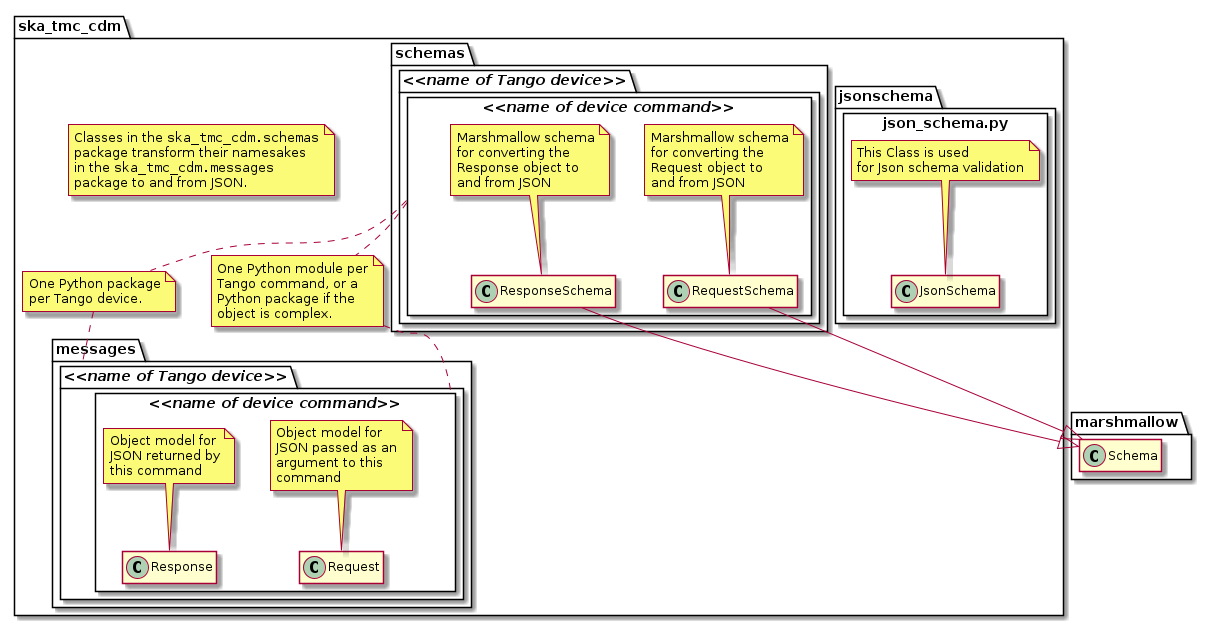
Project layout and naming conventions.
The project layout and naming conventions are:
Each Tango device has a corresponding Python sub-package in
ska_tmc_cdm.messages.Accepted format for each Tango device command is specified as Python models inside their respective packages.
Structured input for the Tango command is modelled by a
Requestobject.Structured output from the command is modelled by a
Responseobject.
Messages
The Python object model for the JSON defined in the ICD is located in the
ska_tmc_cdm.messages package. In general, each CDM JSON entity is represented
as a Pydantic model and each CDM attribute presented as a class property.
CDM attributes can be typed as plain Python data types (strings, floats, etc.) or, where appropriate, represented by rich objects if this provides additional value to the client. For example, while astronomical coordinates are represented by floats and strings in the JSON schema, in the object model they are defined as Astropy SkyCoord instances to ensure ensure correct coordinate handling and permit easier manipulation downstream. Similarly, quantities with units could be defined as instances of Astropy Quantity to provide additional functionality.
For details on the device messages modelled by this library, see:
JSON Schemas
The CDM library uses the SKA Telescope Model to ensure the JSON accepted and JSON generated by the library are compliant with the schema declared by the data.
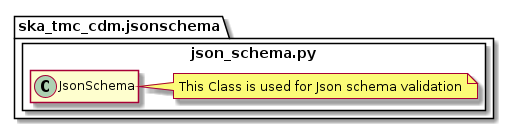
The entry points for code handling JSON schema validation is located in
the ska_tmc_cdm.jsonschema module. This module contains methods for fetching
version-specific JSON schemas using interface URI and validating the structure
of JSON against these schemas. Json Schema validation functionality is enabled
by default with the parameter validate=True when converting a
JSON string to CDM using ska_tmc_cdm.schemas.CODEC.loads() and when converting
CDM to a JSON string using ska_tmc_cdm.schemas.CODEC.dumps().
Extending the CDM
Additional devices and applications cay use this library to communicate CDM elements wherever useful. Developers are encouraged to extend the ska-tmc-cdm project, adding object models and schemas for the structured arguments for their Tango devices.
The steps to extend the CDM are:
Create a new package for the Tango device in
ska_tmc_cdm.messages.For each device command, create a new module in the new package.
If the command accepts structured input, define a
Requestclass in the module.If the command returns a structured response, define a
Responseclass in the module.