Requesting a Local Sky Model
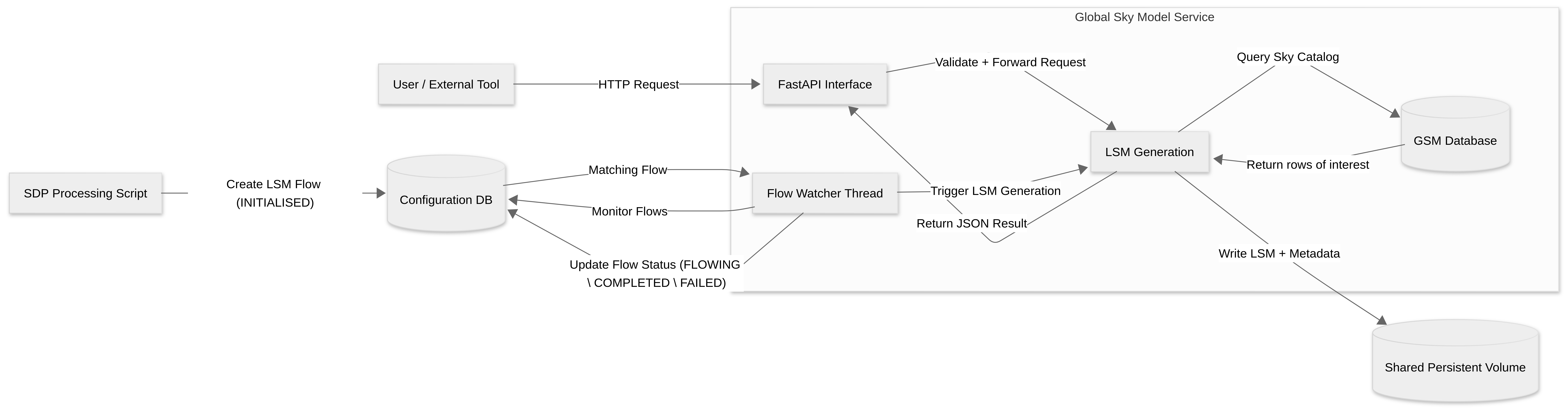
The main purpose of the GSM is to provide a service for requesting LSM data for processing pipelines to use. Alternatively, the service also provides an API (see Viewing LSM data in a browser) to obtain the data. The following flow chart describes the two paths by which one can request an LSM.
SDP Processing
In the SDP, processing scripts request the deployment of various processing pipelines, including, e.g. the realtime calibration pipeline, the instrumental calibration pipeline or the iterative calibration pipeline. All of these pipelines require an LSM to be available for their calibration processes to run with high accuracy.
The process to request an LSM follows the SDP architecture. Processing scripts specify the request parameters via data flow entities (see ADR-81), which are stored in the SDP Configuration database (Config DB).
The GSM Service continuously monitors the Config DB for new LSM requests, and when it finds one, it extracts the query parameters, then queries the PostgreSQL database using Q3C (Quad-tree Cube)-based queries. The returned data are then stored in a CSV file (one per LSM request) in a location that is specified by the data flow entity and is accessible to both the GSM service and the processing pipelines.
The user guide provides examples of how one can set up their processing scripts for this process and what the GSM requires in its query parameters: Requesting Local Sky Model data.
LSM file contents
The CSV file format used to save the LSM data is described at
Using the QC3 extension
Q3C (Quad-tree Cube) is a PostgreSQL extension for fast spatial indexing on the sphere. It maps spherical coordinates (RA/DEC) to an integer pixel index using a quad-tree projection of the sky. RA/Dec pairs are mapped to a quad-tree pixel index on the sphere (using “q3c_ang2ipix”). Q3C automatically determines which q3c pixels intersect the search circle, and uses the index to restrict the candidate set before computing exact distances between rows in the table and the centre of the search. This prunes huge parts of the table without checking every row, thus speeding up the search time.
Database Query Details
The LSM query uses the following approach:
Spatial Query: Uses PostgreSQL’s q3c extension to efficiently find components within a circular region defined by RA, Dec, and FOV radius (all in degrees).
Data Retrieval: For each matched source, the system retrieves:
Component position (RA, Dec) and identifier
Stokes parameters (I, Q, U, V polarization)
Source shape parameters (major/minor axes, position angle)
Spectral index information
Data Model Mapping: Database records are mapped to the GlobalSkyModel data structure defined in ska_sdp_datamodels.global_sky_model:
GlobalSkyModel: Top-level container with metadata and a dictionary of componentsSkyComponent: Contains component ID, position (RA, Dec), Stokes parameters, morphology (major_ax, minor_ax, pos_ang), and spectral index as a list of coefficients
Result Format: Returns a
GlobalSkyModelobject containing a dictionary ofSkyComponentobjects (keyed by component ID) with all relevant astronomical measurements for components within the requested field of view.Output Format: The LSM is written as a CSV file with named columns matching the
SkyComponentdataclass fields. Metadata is written as a YAML file in the parent directory as specified in the Flow configuration.