Low CBF Alarms
Low CBF Alarms will be generated and configured via the Elettra AlarmHandler
Tango device.
Purpose
Why do all control systems have alarms?
To bring an operator’s attention to something that needs intervention within a short time.
Alarms vs Health
Alarms and Health are different things.
An alarm is defined in IEC 62682 as:
An audible and/or visible means of indicating to the operator of an equipment malfunction, process deviation, or abnormal condition requiring a response.
We define health as:
A device’s ability to perform its function.
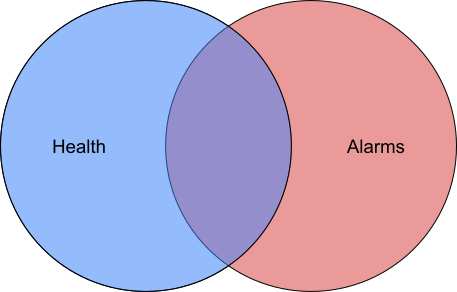
One is not a subset of the other, although there is some overlap. Some parameters that trigger alarms may lead to a change in health state, others may not. Some parameters that are used to calculate health state will have alarms associated with them, some may not. A failed health state in some devices may be alarmed, others may not.
Low CBF devices will provide many diagnostic attributes which may or may not be used
as alarms in the operating telescope. Alarm annunciation and configuration will be via
an instance of the Elettra AlarmHandler Tango device. Its configuration includes a
“formula” that is evaluated to trigger an alarm, alarm priority, group, etc.
Note
An attribute that has an AttrQuality status of ALARM does not necessarily
result in an alarm being announced to the operator! All operator alarms will be
configured and announced via an AlarmHandler Tango device.
Alerts
Alerts are like an alarm that is not time critical. They probably go to a log for later viewing, rather than triggering flashing lights and sirens.
These will be handled via AlarmHandler too. Its configuration will control whether
a given scenario triggers an alarm or alert.
Scope
Alarm management must be a multi-disciplined approach including operations and maintenance people, and is therefore impossible for the Perentie team to perform in isolation.
Our scope is to provide the ability for alarms to be generated on as many diagnostic parameters as we think might be useful for successful commissioning, operation and maintenance.
Alarm Implementation in Low CBF
Alarms will be generated and configured via the Elettra AlarmHandler Tango device.
For the purpose of this document, “Low CBF Tango devices” means Tango devices written
specifically for Low CBF. That’s the Controller, Subarray, Connector, Processor, and
Allocator (CNIC, being a test/debug tool, is not expected to have alarms). In contrast,
the AlarmHandler is not a Low CBF device.
Low CBF Tango devices have a range of Tango attributes for various purposes: internal
control parameters, health monitoring, telescope operation monitoring, diagnostics,
troubleshooting of faults, and so on. However, the Low CBF devices themselves will not
raise alarms to an operator (or maintainer or anyone else). Alarms will be solely
administered and controlled via AlarmHandler.
Configuration of AlarmHandler is outside the scope of this document.
Processor Alarms
The following LowCbfProcessor health related Tango attributes have alarms associated with them. There are rules associated with these attributes which are used to configure AlarmHandler in order to present alarms to the operator using a relevant front end (GUI) system.
Note
This is work in progress - more alarms may be added, existing alarms are subject to change.
hardware_fpga_temperaturehardware_fpga_powerhardware_hbm_temperaturehardware_power_supply_12v_voltagehardware_power_supply_12v_currenthardware_pcie_12v_voltagehardware_pcie_12v_current
The operational limits are specified in a YAML file (see LINK)
monitoring_points:
  fpga_temperature:
    min: 5.0
    max: 105.0
    label: FPGA temperature
    units: "℃"
  fpga_power:
    min: 0.0
    max: 150.0
    label: FPGA power
    units: W
  hbm_temperature:
    min: 5.0
    max: 100.0
    label: HBM temperature
    units: "℃"
  power_supply_12v_voltage:
    min: 11.4
    max: 12.6
    label: 'AUX 12V supply voltage'
    units: V
  power_supply_12v_current:
    min: 0.0
    max: 12.5
    label: 'AUX 12V supply current'
    units: A
  pcie_12v_voltage:
    min: 11.4
    max: 12.6
    label: PCIe 12V supply voltage
    units: V
  pcie_12v_current:
    min: 0.0
    max: 12.5
    label: PCIe 12V supply current
    units: A
Attributes & Quality
The set of attributes exposed by Low CBF devices will be static (Tango’s dynamic attribute feature will not be used). This means that in some circumstances, there will be attributes that are not applicable to the current state of the system.
Low CBF Tango devices use the Tango AttrQuality mechanism to indicate
when attributes are VALID for use, or INVALID (i.e. irrelevant because of current
configuration or state). Alarms therefore must consider attribute quality in their
evaluation.