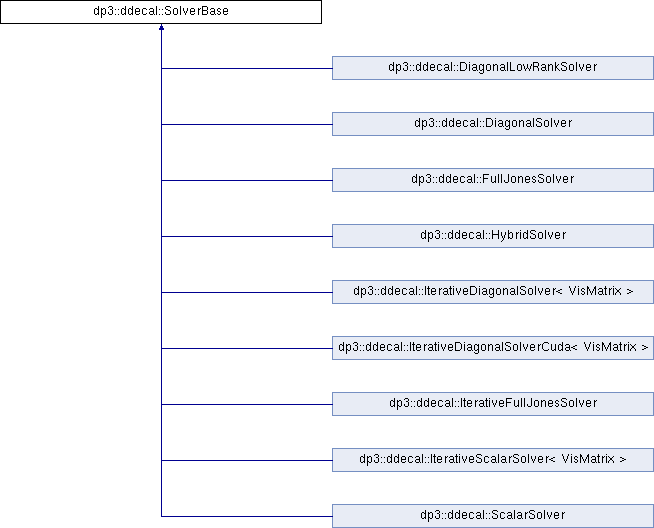
#include <SolverBase.h>
|
| typedef std::complex< float > | Complex |
| |
| typedef std::complex< double > | DComplex |
| |
|
| | SolverBase () |
| |
| virtual | ~SolverBase ()=default |
| |
| void | AddConstraint (std::unique_ptr< Constraint > constraint) |
| |
| virtual std::vector< SolverBase * > | ConstraintSolvers () |
| |
| const std::vector< std::unique_ptr< Constraint > > & | GetConstraints () |
| |
| LLSSolverType | GetLLSSolverType () const |
| |
| bool | GetPhaseOnly () const |
| |
| void | GetTimings (std::ostream &os, double duration) const |
| |
| virtual void | Initialize (size_t n_antennas, const std::vector< size_t > &n_solutions_per_direction, size_t n_channel_blocks) |
| |
| virtual size_t | NSolutionPolarizations () const =0 |
| |
| void | SetDdConstraintWeights (const std::vector< std::vector< double >> &weights) |
| |
| void | SetLLSSolverType (LLSSolverType solver_type) |
| |
| void | SetPhaseOnly (bool phase_only) |
| |
| virtual SolveResult | Solve (const DuoSolveData &data, std::vector< std::vector< DComplex >> &solutions, double time) |
| |
| virtual SolveResult | Solve (const FullSolveData &data, std::vector< std::vector< DComplex >> &solutions, double time) |
| |
| virtual SolveResult | Solve (const UniSolveData &data, std::vector< std::vector< DComplex >> &solutions, double time) |
| |
| virtual bool | SupportsDdSolutionIntervals () const |
| |
|
| size_t | GetMaxIterations () const |
| |
| void | SetMaxIterations (size_t max_iterations) |
| |
|
| size_t | GetMinIterations () const |
| |
| void | SetMinIterations (size_t min_iterations) |
| |
|
| void | SetAccuracy (double accuracy) |
| |
| double | GetAccuracy () const |
| |
|
| void | SetConstraintAccuracy (double constraint_accuracy) |
| |
| double | GetConstraintAccuracy () const |
| |
|
| void | SetStepSize (double step_size) |
| |
| double | GetStepSize () const |
| |
|
| void | SetDetectStalling (bool detect_stalling, double step_diff_sigma) |
| |
| bool | GetDetectStalling () const |
| |
|
| bool | ApplyConstraints (size_t iteration, double time, bool has_previously_converged, SolutionSpan &next_solutions) const |
| |
| bool | ApplyConstraints (size_t iteration, double time, bool has_previously_converged, SolutionTensor &next_solutions) const |
| |
| bool | AssignSolutions (std::vector< std::vector< DComplex >> &solutions, SolutionSpan &new_solutions, bool use_constraint_accuracy, double &avg_abs_diff, std::vector< double > &step_magnitudes) const |
| |
| bool | AssignSolutions (std::vector< std::vector< DComplex >> &solutions, SolutionTensor &new_solutions, bool use_constraint_accuracy, double &avg_abs_diff, std::vector< double > &step_magnitudes) const |
| |
| std::unique_ptr< LLSSolver > | CreateLLSSolver (size_t m, size_t n, size_t nrhs) const |
| |
| bool | DetectStall (size_t iteration, const std::vector< double > &step_magnitudes) |
| |
| std::unique_ptr< aocommon::RecursiveFor > | MakeOptionalRecursiveFor () const |
| |
| SolveResult | MakeResult (size_t iteration, bool has_converged, bool constraints_satisfied) const |
| |
| size_t | NAntennas () const |
| |
| size_t | NChannelBlocks () const |
| |
| size_t | NDirections () const |
| |
| size_t | NSubSolutions () const |
| |
| size_t | NSubThreads () const |
| |
| size_t | NVisibilities () const |
| |
| void | PrepareConstraints () |
| |
| bool | ReachedStoppingCriterion (size_t iteration, bool has_converged, bool constraints_satisfied, const std::vector< double > &step_magnitudes) |
| |
| void | Step (const std::vector< std::vector< DComplex >> &solutions, SolutionTensor &next_solutions) const |
| |
◆ Complex
◆ DComplex
◆ SolverBase()
| dp3::ddecal::SolverBase::SolverBase |
( |
| ) |
|
◆ ~SolverBase()
| virtual dp3::ddecal::SolverBase::~SolverBase |
( |
| ) |
|
|
virtualdefault |
◆ AddConstraint()
| void dp3::ddecal::SolverBase::AddConstraint |
( |
std::unique_ptr< Constraint > |
constraint | ) |
|
|
inline |
Add a constraint to the solver.
- Parameters
-
| constraint | A valid constraint pointer, must not be nullptr. |
◆ ApplyConstraints() [1/2]
| bool dp3::ddecal::SolverBase::ApplyConstraints |
( |
size_t |
iteration, |
|
|
double |
time, |
|
|
bool |
has_previously_converged, |
|
|
SolutionSpan & |
next_solutions |
|
) |
| const |
|
protected |
◆ ApplyConstraints() [2/2]
| bool dp3::ddecal::SolverBase::ApplyConstraints |
( |
size_t |
iteration, |
|
|
double |
time, |
|
|
bool |
has_previously_converged, |
|
|
SolutionTensor & |
next_solutions |
|
) |
| const |
|
protected |
◆ AssignSolutions() [1/2]
| bool dp3::ddecal::SolverBase::AssignSolutions |
( |
std::vector< std::vector< DComplex >> & |
solutions, |
|
|
SolutionSpan & |
new_solutions, |
|
|
bool |
use_constraint_accuracy, |
|
|
double & |
avg_abs_diff, |
|
|
std::vector< double > & |
step_magnitudes |
|
) |
| const |
|
protected |
◆ AssignSolutions() [2/2]
| bool dp3::ddecal::SolverBase::AssignSolutions |
( |
std::vector< std::vector< DComplex >> & |
solutions, |
|
|
SolutionTensor & |
new_solutions, |
|
|
bool |
use_constraint_accuracy, |
|
|
double & |
avg_abs_diff, |
|
|
std::vector< double > & |
step_magnitudes |
|
) |
| const |
|
protected |
Assign the solutions in nextSolutions to the solutions.
- Returns
- whether the solutions have converged. Appends the current step magnitude to step_magnitudes
◆ ConstraintSolvers()
| virtual std::vector<SolverBase*> dp3::ddecal::SolverBase::ConstraintSolvers |
( |
| ) |
|
|
inlinevirtual |
Returns a list of solvers that this solver uses and for which constraints should be set up. The HybridSolver overrides this function to make it possible to initialize the solvers it combines.
Reimplemented in dp3::ddecal::HybridSolver.
◆ CreateLLSSolver()
| std::unique_ptr<LLSSolver> dp3::ddecal::SolverBase::CreateLLSSolver |
( |
size_t |
m, |
|
|
size_t |
n, |
|
|
size_t |
nrhs |
|
) |
| const |
|
protected |
Create an LLSSolver with the given matrix dimensions. Set the tolerance using 'iteration_fraction' and 'solver_precision'.
◆ DetectStall()
| bool dp3::ddecal::SolverBase::DetectStall |
( |
size_t |
iteration, |
|
|
const std::vector< double > & |
step_magnitudes |
|
) |
| |
|
protected |
◆ GetAccuracy()
| double dp3::ddecal::SolverBase::GetAccuracy |
( |
| ) |
const |
|
inline |
◆ GetConstraintAccuracy()
| double dp3::ddecal::SolverBase::GetConstraintAccuracy |
( |
| ) |
const |
|
inline |
◆ GetConstraints()
| const std::vector<std::unique_ptr<Constraint> >& dp3::ddecal::SolverBase::GetConstraints |
( |
| ) |
|
|
inline |
Get the constraints for the solver.
- Returns
- A non-modifiable list of modifiable Constraints. All pointers in the list are valid.
◆ GetDetectStalling()
| bool dp3::ddecal::SolverBase::GetDetectStalling |
( |
| ) |
const |
|
inline |
◆ GetLLSSolverType()
| LLSSolverType dp3::ddecal::SolverBase::GetLLSSolverType |
( |
| ) |
const |
|
inline |
◆ GetMaxIterations()
| size_t dp3::ddecal::SolverBase::GetMaxIterations |
( |
| ) |
const |
|
inline |
Max nr of iterations (stopping criterion).
◆ GetMinIterations()
| size_t dp3::ddecal::SolverBase::GetMinIterations |
( |
| ) |
const |
|
inline |
Min nr of iterations before stopping.
◆ GetPhaseOnly()
| bool dp3::ddecal::SolverBase::GetPhaseOnly |
( |
| ) |
const |
|
inline |
If enabled, the solver will perform steps along the complex circle, instead of moving freely through complex space. See the implementation of MakeStep(). {
◆ GetStepSize()
| double dp3::ddecal::SolverBase::GetStepSize |
( |
| ) |
const |
|
inline |
◆ GetTimings()
| void dp3::ddecal::SolverBase::GetTimings |
( |
std::ostream & |
os, |
|
|
double |
duration |
|
) |
| const |
Output timing information to a stream.
◆ Initialize()
| virtual void dp3::ddecal::SolverBase::Initialize |
( |
size_t |
n_antennas, |
|
|
const std::vector< size_t > & |
n_solutions_per_direction, |
|
|
size_t |
n_channel_blocks |
|
) |
| |
|
virtual |
Prepares the solver with the given dimensionality info and antenna mapping. The antenna arrays map the data provided in @Solve to the antennas.
Reimplemented in dp3::ddecal::HybridSolver.
◆ MakeOptionalRecursiveFor()
| std::unique_ptr<aocommon::RecursiveFor> dp3::ddecal::SolverBase::MakeOptionalRecursiveFor |
( |
| ) |
const |
|
protected |
If useful, make a RecursiveFor object. The existance of a RecursiveFor makes the StaticFor use the RecursiveFor. Using a StaticFor inside a RecursiveFor allows nested parallelization, but it is slower. Therefore, if no nested parallelization can be done, don't create a RecursiveFor. See also NSubThreads().
◆ MakeResult()
| SolveResult dp3::ddecal::SolverBase::MakeResult |
( |
size_t |
iteration, |
|
|
bool |
has_converged, |
|
|
bool |
constraints_satisfied |
|
) |
| const |
|
protected |
◆ MakeSolutionsFinite1Pol()
| static void dp3::ddecal::SolverBase::MakeSolutionsFinite1Pol |
( |
std::vector< std::vector< DComplex >> & |
solutions | ) |
|
|
staticprotected |
◆ MakeSolutionsFinite2Pol()
| static void dp3::ddecal::SolverBase::MakeSolutionsFinite2Pol |
( |
std::vector< std::vector< DComplex >> & |
solutions | ) |
|
|
staticprotected |
◆ MakeSolutionsFinite4Pol()
| static void dp3::ddecal::SolverBase::MakeSolutionsFinite4Pol |
( |
std::vector< std::vector< DComplex >> & |
solutions | ) |
|
|
staticprotected |
◆ NAntennas()
| size_t dp3::ddecal::SolverBase::NAntennas |
( |
| ) |
const |
|
inlineprotected |
◆ NChannelBlocks()
| size_t dp3::ddecal::SolverBase::NChannelBlocks |
( |
| ) |
const |
|
inlineprotected |
◆ NDirections()
| size_t dp3::ddecal::SolverBase::NDirections |
( |
| ) |
const |
|
inlineprotected |
◆ NSolutionPolarizations()
| virtual size_t dp3::ddecal::SolverBase::NSolutionPolarizations |
( |
| ) |
const |
|
pure virtual |
◆ NSubSolutions()
| size_t dp3::ddecal::SolverBase::NSubSolutions |
( |
| ) |
const |
|
inlineprotected |
Total number of solutions over all directions This might be different from n_directions_ when using direction-dependent intervals.
◆ NSubThreads()
| size_t dp3::ddecal::SolverBase::NSubThreads |
( |
| ) |
const |
|
protected |
Returns the number of available thread for one channel. This assumes that the channel blocks is the main direction that is parallelized over (as all solvers are currently doing). For example, if there are 20 threads available, and the number of channel blocks is 10, then 2 is returned, because each channel block can use two threads to fill up the cpu. The returned value is at least 1.
◆ NVisibilities()
| size_t dp3::ddecal::SolverBase::NVisibilities |
( |
| ) |
const |
|
inlineprotected |
Total number of visibilities over all channel blocks
◆ PrepareConstraints()
| void dp3::ddecal::SolverBase::PrepareConstraints |
( |
| ) |
|
|
protected |
◆ ReachedStoppingCriterion()
| bool dp3::ddecal::SolverBase::ReachedStoppingCriterion |
( |
size_t |
iteration, |
|
|
bool |
has_converged, |
|
|
bool |
constraints_satisfied, |
|
|
const std::vector< double > & |
step_magnitudes |
|
) |
| |
|
inlineprotected |
◆ SetAccuracy()
| void dp3::ddecal::SolverBase::SetAccuracy |
( |
double |
accuracy | ) |
|
|
inline |
Required relative accuracy.
◆ SetConstraintAccuracy()
| void dp3::ddecal::SolverBase::SetConstraintAccuracy |
( |
double |
constraint_accuracy | ) |
|
|
inline |
Required relative accuracy for the constraints to finish.
◆ SetDdConstraintWeights()
| void dp3::ddecal::SolverBase::SetDdConstraintWeights |
( |
const std::vector< std::vector< double >> & |
weights | ) |
|
Calls SetSolutionWeights() for all constraints.
◆ SetDetectStalling()
| void dp3::ddecal::SolverBase::SetDetectStalling |
( |
bool |
detect_stalling, |
|
|
double |
step_diff_sigma |
|
) |
| |
|
inline |
Whether stalling of the solutions should abort the solving.
◆ SetLLSSolverType()
| void dp3::ddecal::SolverBase::SetLLSSolverType |
( |
LLSSolverType |
solver_type | ) |
|
◆ SetMaxIterations()
| void dp3::ddecal::SolverBase::SetMaxIterations |
( |
size_t |
max_iterations | ) |
|
|
inline |
◆ SetMinIterations()
| void dp3::ddecal::SolverBase::SetMinIterations |
( |
size_t |
min_iterations | ) |
|
|
inline |
◆ SetPhaseOnly()
| void dp3::ddecal::SolverBase::SetPhaseOnly |
( |
bool |
phase_only | ) |
|
|
inline |
◆ SetStepSize()
| void dp3::ddecal::SolverBase::SetStepSize |
( |
double |
step_size | ) |
|
|
inline |
The step size taken each iteration. Higher values might make convergence faster, but may cause instability.
◆ Solve() [1/3]
◆ Solve() [2/3]
◆ Solve() [3/3]
◆ Step()
| void dp3::ddecal::SolverBase::Step |
( |
const std::vector< std::vector< DComplex >> & |
solutions, |
|
|
SolutionTensor & |
next_solutions |
|
) |
| const |
|
protected |
◆ SupportsDdSolutionIntervals()
| virtual bool dp3::ddecal::SolverBase::SupportsDdSolutionIntervals |
( |
| ) |
const |
|
inlinevirtual |
The documentation for this class was generated from the following file: