#include <SmoothnessConstraint.h>
◆ SmoothnessConstraint()
| dp3::ddecal::SmoothnessConstraint::SmoothnessConstraint |
( |
double |
bandwidth_hz, |
|
|
double |
bandwidth_ref_frequency_hz, |
|
|
double |
spectral_exponent, |
|
|
bool |
kernel_truncation |
|
) |
| |
- Parameters
-
| bandwidth_hz | Size of the kernel (smoothing strength) |
| bandwidth_ref_frequency_hz | Reference frequency for the kernel size, may be zero to have a constant kernel size over frequency. |
- See also
- KernelSmoother documentation.
◆ Apply()
| void dp3::ddecal::SmoothnessConstraint::Apply |
( |
SolutionSpan & |
solutions, |
|
|
double |
time |
|
) |
| |
|
overridevirtual |
This method applies the constraints to the solutions.
- Parameters
-
| solutions | A 4D array with dimensions n_channel_blocks x n_antennas x n_sub_solutions x n_pol solutions. n_pol is the dimension with the fastest changing index. Using a span instead of a real tensor as argument type avoids the need for copying data in Python bindings. |
| time | Central time of interval. |
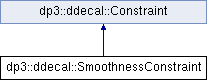
Implements dp3::ddecal::Constraint.
◆ GetAntennaFactors()
| const std::vector<double>& dp3::ddecal::SmoothnessConstraint::GetAntennaFactors |
( |
| ) |
const |
|
inline |
◆ GetDdSmoothingFactors()
| const std::vector<double>& dp3::ddecal::SmoothnessConstraint::GetDdSmoothingFactors |
( |
| ) |
const |
|
inline |
◆ Initialize()
| void dp3::ddecal::SmoothnessConstraint::Initialize |
( |
size_t |
n_antennas, |
|
|
const std::vector< uint32_t > & |
solutions_per_direction, |
|
|
const std::vector< double > & |
frequencies |
|
) |
| |
|
overridevirtual |
Perform common constraint initialization. Should be overridden when something more than assigning dimensions is needed (e.g. resizing vectors).
- Parameters
-
| frequencies | For each channel block, the mean frequency. |
Reimplemented from dp3::ddecal::Constraint.
◆ SetAntennaFactors()
| void dp3::ddecal::SmoothnessConstraint::SetAntennaFactors |
( |
std::vector< double > && |
antenna_factors | ) |
|
|
inline |
Set antenna smoothness factors that can control the amount of smoothing per antenna. One option is e.g. to let this depend on the distance to the array centre.
- Note
- Because distance is the common use-case for these factors, the factors work opposite of the dd smoothing factors: higher values cause less smoothing.
- Parameters
-
| antenna_factors | vector where each element is a smoothing correction factor for each antenna. A higher correction factor will perform stronger smoothing in frequency direction. |
◆ SetDdSmoothingFactors()
| void dp3::ddecal::SmoothnessConstraint::SetDdSmoothingFactors |
( |
std::vector< double > |
dd_smoothing_factors | ) |
|
Sets an extra (cummulative) smoothing factor for directions (and dd solution intervals).
- Note
- that these factors have opposite meaning of those for SetAntennaFactors().
- Parameters
-
| dd_smoothing_factors | should be of size NSubSolutions(), i.e. it should have a factor for each direction and the possible subsolutions per direction. The otherwise specified smoothing kernel size is multiplied with these factors, which means that higher values will cause stronger smoothing. If empty, all factors are assumed to be one. |
◆ SetSubSolutionWeights()
| void dp3::ddecal::SmoothnessConstraint::SetSubSolutionWeights |
( |
const std::vector< std::vector< double >> & |
solution_weights | ) |
|
|
inlineoverridevirtual |
Set direction dependent weights. It consists of n_sub_solutions vectors, each of which is an n_antennas * n_channel_blocks vector, where the channel index varies fastest.
If set, the normal weights are not used.
Reimplemented from dp3::ddecal::Constraint.
◆ SetWeights()
| void dp3::ddecal::SmoothnessConstraint::SetWeights |
( |
const std::vector< double > & |
weights | ) |
|
|
inlineoverride |
Set the weights to be used during smoothing.
- Parameters
-
| weights | An array of n_antenna x n_channel_blocks. |
The documentation for this class was generated from the following file:
 Public Member Functions inherited from dp3::ddecal::Constraint