Controller Device
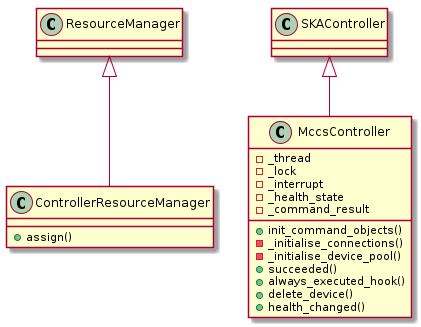
This module contains the SKA Low MCCS Controller device prototype.
- class MccsController(*args: Any, **kwargs: Any)[source]
An implementation of a controller Tango device for MCCS.
- Allocate(argin: str) tuple[list[ska_control_model.ResultCode], list[Optional[str]]][source]
Allocate a set of unallocated MCCS resources to a sub-array.
The JSON argument specifies the overall sub-array composition in terms of which stations should be allocated to the specified Sub-Array.
- Parameters:
argin – JSON-formatted string containing an integer subarray ID, and resources to be allocated to that subarray
- Returns:
A tuple containing a return code, a string message indicating status and message UID. The string message is for information purposes only, but the message UID is for message management use.
- Example:
>>> proxy = tango.DeviceProxy("ska-low-mccs/control/control")
>>> proxy.Allocate(
        json.dumps(
        {
            "interface":
                "https://schema.skao.int/ska-low-mccs-controller-allocate/3.0"
            "subarray_id": 1,
            "subarray_beams": [
                {
                    "subarray_beam_id": 3,
                    "apertures": [
                        {"station_id": 1, "aperture_id": "1.1" },
                        {"station_id": 2, "aperture_id": "2.2" },
                        {"station_id": 2, "aperture_id": "2.3" },
                        {"station_id": 3, "aperture_id": "3.1" },
                        {"station_id": 4, "aperture_id": "4.1" },
                    ],
                }
                "number_of_channels": 32,
            ],
        }
        )
    )
- class AllocateCommand(*args: Any, **kwargs: Any)[source]
Class for handling the Allocate() command.
This command takes as input a JSON string that conforms to the following schema:
schemas/MccsController_Allocate_3_0.json
- __init__(command_tracker: ska_tango_base.base.CommandTracker, component_manager: ControllerComponentManager, callback: Callable | None = None, logger: Logger | None = None) None[source]
Initialise a new AllocateCommand instance.
- Parameters:
command_tracker – the command tracker used to track this command
component_manager – the component manager to which this command belongs.
callback – the callback to be called at command completion
logger – a logger for this command to use.
- GetAssignedResources(subarray_id: int) str[source]
Return a dictionary of the resources assigned to a given subarray.
- Parameters:
subarray_id – The subarray ID of the resources
- Returns:
json formatted dictionary
- GetHealthTrl(argin: str) str | None[source]
Return health of device given by TRL.
- Parameters:
argin – TRL of device to return health of.
- Returns:
health of device given by TRL.
- class InitCommand(*args: Any, **kwargs: Any)[source]
A class for
MccsController’s Init command.- The
do()method below is called during
MccsController’s initialisation.
- do(*args: Any, **kwargs: Any) tuple[ska_control_model.ResultCode, str][source]
Initialise the attributes and properties of the MccsController.
- Parameters:
args – positional args to the component manager method
kwargs – keyword args to the component manager method
- Returns:
A tuple containing a return code and a string message indicating status. The message is for information purpose only.
- The
- Release(argin: str) tuple[list[ska_control_model.ResultCode], list[Optional[str]]][source]
Release resources from an MCCS Sub-Array.
- Parameters:
argin – JSON-formatted string
- Returns:
A tuple containing a return code, a string message indicating status and message UID. The string message is for information purposes only, but the message UID is for message management use.
- Example:
>>> proxy = tango.DeviceProxy("ska-low-mccs/control/control")
>>> proxy.Release(
        json.dumps(
            {
            "subarray_id": 1,
            "release_all": true
            }
        )
    )
- ReleaseAll() tuple[list[ska_control_model.ResultCode], list[Optional[str]]][source]
Release all resources from an MCCS Array.
- Returns:
A tuple containing a return code, a string message indicating status and message UID. The string message is for information purposes only, but the message UID is for message management use.
- Example:
>>> proxy = tango.DeviceProxy("ska-low-mccs/control/control")
>>> proxy.ReleaseAll()
- class ReleaseAllCommand(*args: Any, **kwargs: Any)[source]
Class for handling the ReleaseAll() command.
schemas/MccsController_Release_2_0.json
- __init__(component_manager: ControllerComponentManager, logger: Logger | None = None) None[source]
Initialise a new ReleaseAllCommand instance.
- Parameters:
component_manager – the device to which this command belongs.
logger – a logger for this command to use.
- do(*args: Any, **kwargs: Any) tuple[ska_control_model.ResultCode, str][source]
Implement
MccsController.Release()command functionality.- Parameters:
args – Positional arguments. This should be empty and is provided for type hinting purposes only.
kwargs – keyword arguments unpacked from the JSON argument to the command.
- Returns:
A tuple containing a return code and a string message indicating status. The message is for information purpose only.
- class ReleaseCommand(*args: Any, **kwargs: Any)[source]
Class for handling the Release() command.
This command takes as input a JSON string that conforms to the following schema:
schemas/MccsController_Release_2_0.json
- __init__(component_manager: ControllerComponentManager, logger: Logger | None = None) None[source]
Initialise a new ReleaseCommand instance.
- Parameters:
component_manager – the device to which this command belongs.
logger – a logger for this command to use.
- do(*args: Any, **kwargs: Any) tuple[ska_control_model.ResultCode, str][source]
Implement
MccsController.Release()command functionality.- Parameters:
args – Positional arguments. This should be empty and is provided for type hinting purposes only.
kwargs – keyword arguments unpacked from the JSON argument to the command.
- Returns:
A tuple containing a return code and a string message indicating status. The message is for information purpose only.
- RestartSubarray(argin: int) tuple[list[ska_control_model.ResultCode], list[Optional[str]]][source]
Restart an MCCS subarray.
- Parameters:
argin – an integer subarray_id.
- Returns:
A tuple containing a return code and a string message indicating status. The message is for information purpose only.
- StandbyFull() tuple[list[ska_control_model.ResultCode], list[Optional[str]]][source]
Put MCCS into standby mode.
Some elements of SKA Mid have both low and full standby modes, but SKA Low has no such elements. We just need a Standby command, not separate StandbyLow and StandbyFull.
- Returns:
A tuple containing a return code and a string message indicating status. The message is for information purpose only.
- StandbyLow() tuple[list[ska_control_model.ResultCode], list[Optional[str]]][source]
Put MCCS into standby mode.
Some elements of SKA Mid have both low and full standby modes, but SKA Low has no such elements. We just need a Standby command, not separate StandbyLow and StandbyFull.
- Returns:
A tuple containing a return code and a string message indicating status. The message is for information purpose only.
- __init__(*args: Any, **kwargs: Any) None[source]
Initialise this device object.
- Parameters:
args – positional args to the init
kwargs – keyword args to the init
- buildState() str[source]
Read the Build State of the device.
- Returns:
the build state of the device
- create_component_manager() ControllerComponentManager[source]
Create and return a component manager for this device.
- Returns:
a component manager for this device.
- healthModelParams(argin: str) None[source]
Set the params for health transition rules.
- Parameters:
argin – JSON-string of dictionary of health states
- init_device() None[source]
Initialise the device.
This is overridden here to change the Tango serialisation model.
- missedEvents() int[source]
Get the amount of missed change events.
Some commands rely on change events from sub-devices, sometime we miss these events, this attribute keeps track of how many we know we have missed.
- Returns:
the amount of missed change events
- stationBeamHealths() str[source]
Read the health of station beams controlled by the device.
- Returns:
health of station beams in a json format
- stationHealths() str[source]
Read the health of stations controlled by the device.
- Returns:
health of stations in a json format
- subDeviceHealths() str[source]
Read the health of all subdevices controlled by the device.
- Returns:
health of subdevices in a json tree format
- subarrayBeamHealths() str[source]
Read the health of subarray beams controlled by the device.
- Returns:
health of subarray beams in a json format