

How the Central Artefact Repositories work#
Concepts, architecture, conventions, and the software supply chain that the CARs sit within.
What the CARs provide#
The Central Artefact Repositories are a content management system for software artefacts delivered in their published form. They store and manage artefacts throughout the software development life cycle (SDLC), and must stay stable, long-lived, and able to evolve with SKAO’s requirements as DevSecOps practice matures.
They let you publish and retrieve artefacts using the native tools, processes, and protocols associated with each language or framework. Artefacts are versioned and decorated with extensible metadata that supports their life cycle. The CARs provide APIs and reporting interfaces that integrate with wider DevSecOps processes: CI/CD, software bill of materials (SBOM) and dependency management, licence management, provenance, vulnerability scanning, and release management. They also control access through identity and access management (IAM), and offer notary features for provenance through TLS/SSL and signatures.
Within SKAO, the CARs are the single source of truth for every artefact that enters the software delivery and verification process, through to the curation and maintenance of approved artefacts for production deployment and historical reference for the lifetime of the Observatory. They hold both the canonical reference versions of artefacts and the stateful context of each artefact as it moves from development to deployment to decommissioning.
For the artefact types the CARs support, see the reference page.
Deployment#
The CARs regulate the flow of artefacts through the SDLC and are integrated into every phase of building, testing, and publishing. They ensure that only approved artefacts reach composite products and, eventually, production environments. They are not responsible for delivering artefacts directly to operational environments — high-speed delivery services and caches handle that.
The repository runs on the open-source edition of Nexus Repository Manager 3, hosted on AWS (eu-west-2, London), with a dedicated cache node for resilience. Nexus itself follows a blue/green deployment: two instances stay continuously synchronised, but only one is live at a time. Upgrades and configuration changes land on the inactive instance first and get tested there, and a load-balancer switch is what actually promotes it to live — so routine maintenance, and recovery from an outage on the live instance, both happen as a fast switch-over rather than an in-place change. The System Team’s CAR Nexus setup and migration runbook covers the underlying playbooks, the sync service, and the outage procedure in full. Individual datacentres — for example STFC — also run their own local Nexus caches, so pulling an artefact doesn’t always mean a round trip to the primary repository.
LDAP authentication covers SKAO administration, with a minimal set of additional accounts for publishing artefacts. All repositories grant read-only access to anonymous users. Email notifications are integrated for task notifications.
Artefact conventions#
Naming#
Alongside semantic versioning, every published artefact must follow these naming rules (detailed further in ADR-25 — Software naming conventions):
Prefix the artefact with the namespaced name of the GitLab repository that holds its source code.
Name the artefact after its core function or its GitLab repository name — for example,
ska-tango-examplesnames an artefact after its repository, andska-tango-images-pytango-buildernames one after its function.Follow the semantic versioning standard for the artefact type.
Never use generic version tags such as
latestfor container images.Treat published artefacts as immutable. Release a new version to correct an error rather than re-releasing an existing one.
Expect filters and cleanup policies to purge non-compliant artefacts, and validation hooks to deny publishing of incorrectly named or versioned artefacts — a container image tagged
latestis trapped by a cleanup policy.
Versioning#
Every SKAO developer must version releases the same way, so the GitLab CI/CD pipeline can automate artefact builds. ADR-25 defines the standard for each artefact type in detail; all of them derive from Semantic Versioning 2.0.0 — a dotted Major.Minor.Patch notation, for example 1.2.3.
Validation#
The SKA CI/CD Artefact Validations service — known by its bot identity Marvin (marvin-42-service) — enforces the naming, versioning, and metadata conventions on this page. It receives a webhook from Nexus or Harbor for every published artefact and checks it against these conventions. A non-compliant Nexus artefact is quarantined; a non-compliant Harbor image is labelled and held back from promotion to production. Either way, Marvin reports back in a merge request that GitLab automatically assigns to the developer who triggered the publishing pipeline job. The merge request title names the artefact and its version, and its description tables each failed check alongside instructions to fix it.
For OCI images specifically, passing these checks is not enough to reach production on its own — see The software supply chain for the additional vulnerability and signature gate. See Artefact validations for how this service fits the wider SKAO workflow.
The software supply chain#
The software supply chain covers every stage involved in creating, delivering, and maintaining secure, high-quality software — from development through linting, testing, packaging, distribution, and deployment. It covers software SKAO builds as well as software from the open-source community and third-party vendors. Different package types need different controls: OCI images, for example, bundle thousands of pieces of third-party software, so scanning them for CVEs is critical.
Attention to the packaging and distribution end of the supply chain has grown since the 2021 US Executive Order on Improving the Nation’s Cybersecurity, which pushed the software industry towards SBOMs to strengthen supply chain security.
Supply chain stages#
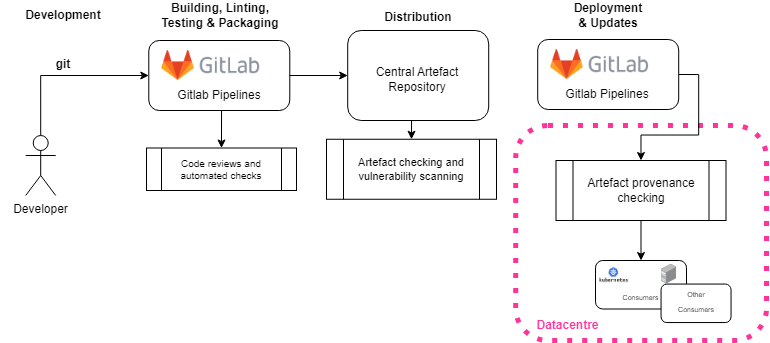
Development — Good design principles and development guidelines secure this stage. A code review policy drives up quality from the start.
Building, linting, and testing — Automated linting, built on community and industry standards for each language, catches bugs, anti-patterns, and inconsistent style. Testing (unit, integration, and system) then confirms the software works correctly and meets functional and performance requirements.
Packaging — Software that passes testing is bundled with its files, libraries, documentation, and other resources into a distributable format: an installer, a server deployment package, or a container image.
Distribution — The packaged software becomes available for deployment. Distribution infrastructure and requirements differ by artefact type — a Python package and an OCI image need different pipelines — so a stable, secure distribution pipeline is essential to overall supply chain security.
Deployment — The software is installed and configured in its target environment: individual servers or cloud platforms, including configuration, databases, integrations, and secret handling.
Maintenance and updates — Ongoing bug fixes, security patches, and feature updates keep the software functioning securely.
The pipeline machinery GitLab templates and Makefile submodules provide the infrastructure and procedures for the most widely used technologies across all of these stages, so development teams can meet supply chain requirements without building this tooling themselves. Release procedures receive particular attention, since they govern both software distribution and project-wide visibility.
SKAO’s supply chain infrastructure#
SKAO delivers most artefact types — Apt packages, C/C++ libraries, Python packages, Helm charts, raw packages, and OCI images — through the same infrastructure:
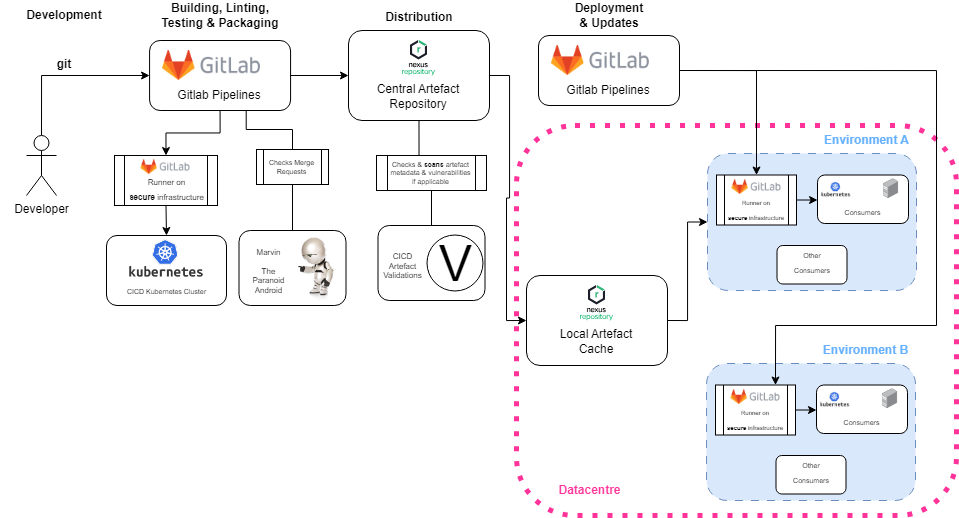
From development to deployment, this infrastructure relies on GitLab and the pipeline machinery, together with the CI/CD Kubernetes cluster (STFC) that runs secure, non-shared GitLab runners for CI tasks. These runners execute pipelines on SKAO’s own infrastructure and publish packages to the CARs. Each datacentre — which can host multiple environments — also runs a local cache to speed up deployment.
The supply chain protects each stage as follows:
Development — Developers hold repository-specific GitLab permissions and use 2FA.
Building, linting, testing, and packaging — Secure, self-hosted runners keep pipeline secrets off shared infrastructure and identify themselves to upstream distribution systems. Marvin (Merge request quality checks), the SKA MR Service’s bot identity, checks every merge request for compliance with SKAO guidelines and reports on its contents, documentation, and standards.
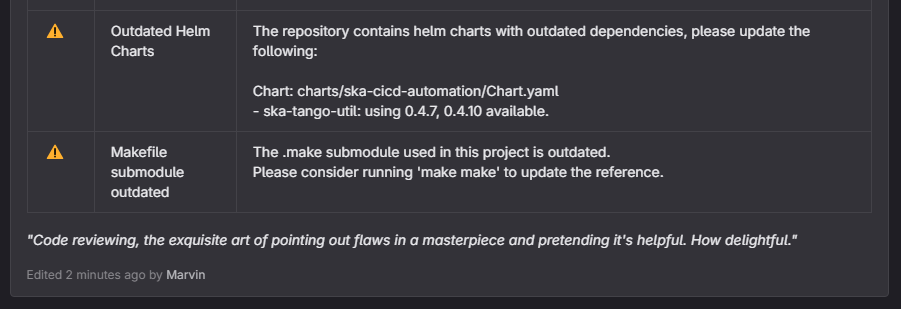
Distribution — Credential-protected systems require authentication to push artefacts. The same Marvin bot identity also fronts the separate artefact validations service, which quarantines non-compliant Nexus artefacts and, for Harbor images, gates promotion from
stagingtoproductionon both a clear vulnerability scan (Trivy) and a valid signature.Deployment and updates — Secure runners handle deployment on the same infrastructure used to build artefacts, eliminating tampering opportunities.
OCI images move through Harbor rather than Nexus: it gives a clearer view of signatures and can block images that carry critical vulnerabilities or lack one. SKAO signs both the OCI image and its software bill of materials (SBOM) with Notation, incubating under the CNCF, using a certificate issued by Vault — the artefact validations service signs the SBOM itself once the image passes its checks. This lets downstream consumers verify an artefact’s provenance before Podman or Kubernetes deploys it.